Multiple Choice
Identify the
choice that best completes the statement or answers the question.
|
|
|
1.
|
Which of the following is a pure substance?
a. | all of the above | c. | Hydrogen Fluoride and Potassium Oxide (HF + K2O
)
| b. | Magnesium (Mg) | d. | Sodium Chloride and water (NaCl + H2O ) |
|
|
|
2.
|
Of the elements Pt, V, Li, and Kr, which is a nonmetal?
|
|
|
3.
|
Which of the following elements has the smallest atomic radius?
|
|
|
4.
|
Which of the following changes to a metal is a chemical change?
a. | rusting | b. | polishing | c. | melting | d. | bending |
|
|
|
5.
|
Which of the following is considered a physical property of a substance?
a. | products of decomposition | b. | reaction with an acid | c. | malleability
| d. | ability to oxidize |
|
|
|
6.
|
Sodium, mercury, argon and neon are used in the production of lamps. There are
fewer safety guidelines regarding the handling of neon and argon than for mercury and sodium. Which
of the following best describes the properties of elements in the same family as neon and
argon?
a. | Solid at room temperature | c. | Mostly
unreactive | b. | Solid at room temperature and mostly unreactive with strong acids | d. | Gaseous at room temperature and highly
reactive |
|
|
|
7.
|
Which of the following statements is an accurate description of the ionization
energies of elements within the periodic table?
a. | The ionization energy of magnesium is greater than that of sulfur.
| c. | The ionization
energy of krypton is greater than that of neon.
| b. | The ionization energy of iodine is greater than
that of fluorine. | d. | The
ionization energy of sulfur is greater than that of potassium.
|
|
|
|
8.
|
Chemist can identify the composition of some unknown salts
by conducting a flame test. When potassium salts are heated in a flame, a purple color is observed.
What is the electron configuration of a Potassium (K) atom?
a. | 1s2 2s2 2p6 3s2
3p6 4s1 | c. | 1s2
2s2 2d6 3s2 3p6
4s2 | b. | 1s2 2s2
2p6 3s2 3p6 4d1
| d. | 1s2 2s2 2p6 3s2 3p6
3d1 |
|
|
|
9.
|
What element has the following electron configuration:
1s2 2s2 2p6 3s2 3p6 4s2
3d104p65s24d8 ?
a. | Platinum (Pt)
| c. | Nickel (Ni)
| b. | Tin (Sn) | d. | Palladium
(Pd) |
|
|
|
10.
|
Which of the following statements is true?
a. | Electrons are negatively charged and have a mass of 1 amu. | b. | The nucleus of an
atom is positively charged and never has a mass of 1 amu. | c. | Neutrons are
negatively charged and have a mass of 1 amu. | d. | Protons are positively charged and have a mass
of 1 amu. |
|
|
|
11.
|
One of the wavelengths emitted by hydrogen atoms is
6.56 x 10⁻⁷ m. Calculate
the frequency if the speed of light is 3.00 x 10⁸ m/s..
a. | 4.57 x 10¹⁴ Hz | c. | 1.97 x 10¹⁴
Hz | b. | 4.57 x 10⁻⁷ Hz | d. | 4.57 x 10⁻⁶ Hz |
|
|
|
12.
|
Which of the following factors contributes to the increase in ionization energy
from left to right across a period?
a. | an increase in the shielding effect | b. | fewer electrons in the highest occupied energy
level | c. | an increase in the number of protons | d. | an increase in the size of the
nucleus |
|
|
|
13.
|
As the wavelength of a wave increases, which is also TRUE?
a. | the frequency increases | c. | the frequency
decreases | b. | planks constant increases | d. | the energy increases |
|
|
|
14.
|
A sample of Element X is found to contain 72.15% of isotope type 1 (84.9118 amu)
and 27.85% of isotope type 2 (86.9092 amu). Calculate the average atomic mass.
a. | 86.21 amu | c. | 85.47 amu | b. | 86.49 amu | d. | 85.13 amu |
|
|
|
15.
|
As wavelength increases, what happens to Frequency and
Energy?
a. | Frequency decreases, Energy increases | c. | Both Decrease | b. | Both
Increase | d. | Frequency increases, Energy decreases |
|
|
|
16.
|
What does the 3 represent in
the following electron configuration, 1s2 2s2 2p6 3s2
3p6?
a. | Energy level of electrons | c. | Electrons | b. | Orbitals | d. | Sublevel |
|
|
|
17.
|
An example of an extensive property of matter is
a. | mass. | b. | hardness. | c. | temperature. | d. | pressure. |
|
|
|
18.
|
Which of the following describes the ability of a metal to be drawn into wires
or be bent?
a. | malleable | c. | ductility | b. | conductivity | d. | soluble |
|
|
|
19.
|
What is the maximum number of orbitals in the p sublevel?
|
|
|
20.
|
How many electrons are required to fill the 3rd energy level
with the maximum number of electrons?
|
|
|
21.
|
Where in an atom is MOST of its mass found?
a. | in electron clouds | c. | in the f orbital | b. | in the nucleus | d. | in the 1s and 2s
orbitals |
|
|
|
22.
|
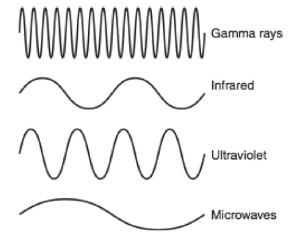
Which of the waves
above has the highest energy?a. | Microwave | c. | Infrared | b. | Gamma | d. | Ultraviolet |
|
|
|
23.
|
What is the Noble Gas electron configuration for an atom of
Germanium (Ge)?
a. | [Kr] 4s2 3d10
4p2 | c. | [Ar]
4s2 4d10 4p2 | b. | [Ar]
4s2 3d10 4p2 | d. | [Kr] 4s2
4d10 4p2 |
|
|
|
24.
|
As the atomic number increases within a group of elements, the atomic radius
usually --
a. | decreases | c. | increases | b. | remains the same as the one above
it | d. | decreases, then
increases |
|
|
|
25.
|
In which of the following is the number of neutrons correctly
represented?
a. |  As has 108 neutrons. As has 108 neutrons. | b. |  U
has 146 neutrons. U
has 146 neutrons. | c. |  F has 0
neutrons. F has 0
neutrons. | d. |  Mg has 24
neutrons. Mg has 24
neutrons. |
|
|
|
26.
|
Brass is an alloy made of copper and zinc. To make brass copper is mixed
with zinc when both metals are at the liquid state. During the mixing process no chemical
reaction takes place. After mixing, brass appears to be uniform throughout. Brass must be
a(n):
a. | heterogenous mixture | c. | homogenous mixture | b. | pure substance | d. | an element |
|
|
|
27.
|
What is the electron configuration for Manganese (Mn),
atomic number 25?
a. | 1s2 2s2 2p6 3s2
3p6 4s2 3d10 | c. | 1s2
2s2 2p6 3s2 3p6 4s2
3d5 | b. | 1s2 2s2
2p6 3s2 3p6 | d. | 1s2 2s2
2p6 3s2 3p6
4s2 |
|
|
|
28.
|
How many valence electrons are in a silicon atom?
|
|
|
29.
|
A red light is measured to have a wavelength of 6.71 x 10⁻⁷ m. Given
the speed of light (3.00 x 10⁸ m/s) and Planck’s constant (6.63 x 10⁻³⁴
Js), calculate the energy of one photon of this light.
a. | 1.48 x 10⁻¹⁸ J | c. | 2.96 x 10⁻¹⁹
J | b. | 4.42 x 10⁻³ J | d. | 1.33 x 10⁻¹⁸ J |
|
|
|
30.
|
How many valence electrons are surrounding an element with
the following electron configuration:
1s2 2s2 2p6 3s2
?
|